ERP Test Automation Best Practice: Scenario Independence
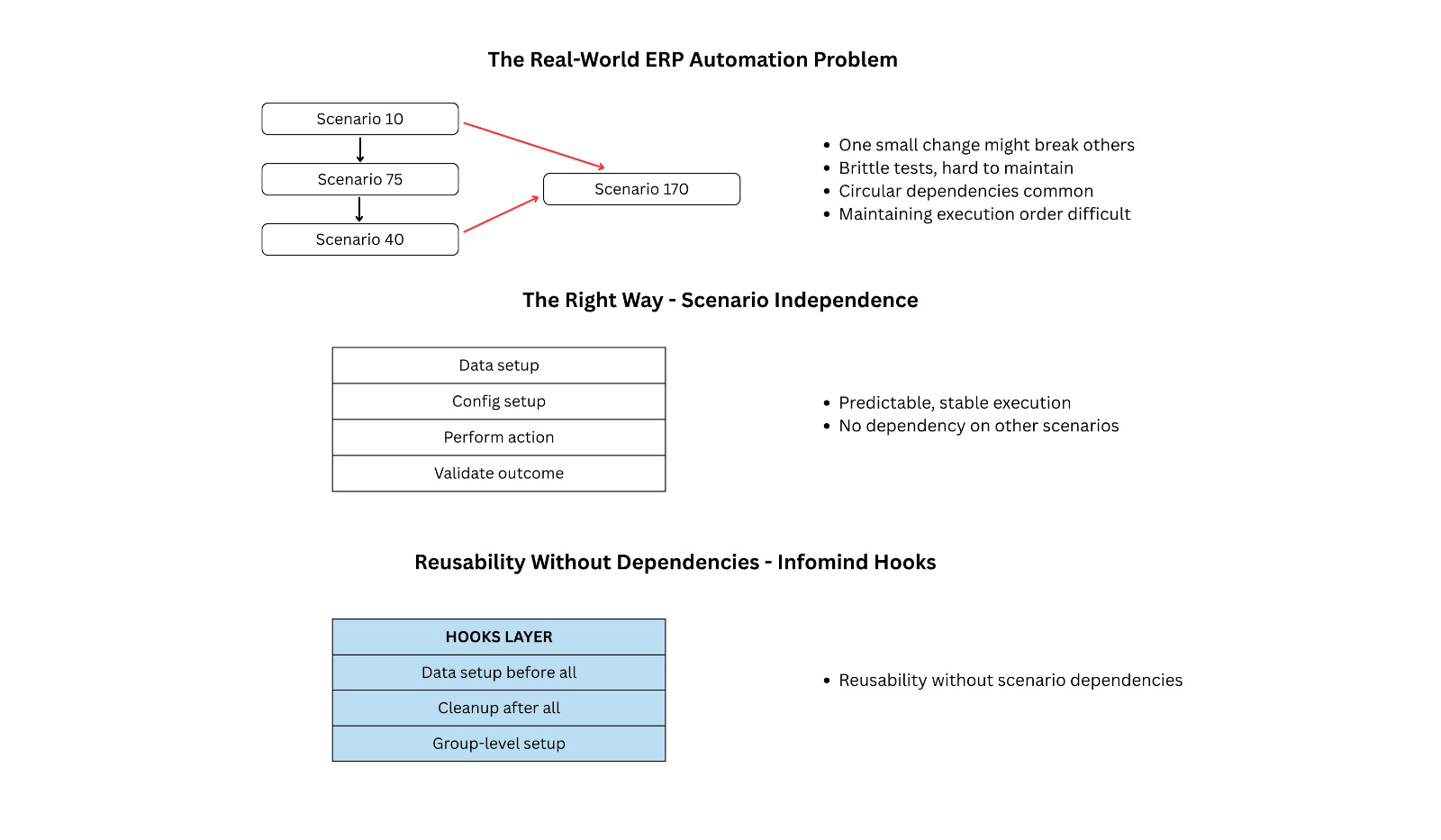
Table of Contents
Why Scenario Independence Is the Cornerstone of Scalable Test Automation
Summary
Problem: As ERP test automation scales to hundreds or thousands of scenarios, scenario interdependencies create fragile, hard-to-maintain test suites where small changes trigger widespread failures.
Solution: Keep every scenario completely independent — handling its own setup, configuration, execution, validation, and cleanup — while using Infomind’s hooks for shared setup logic. This ensures scalability, stability, and maintainability in complex ERP environments.
1. The Real-World ERP Automation Problem
When you automate tests for a large ERP, you quickly face the temptation to build dependencies between scenarios. For example:
Scenario 10 → Scenario 100 → Scenario 150
     ↓
   Scenario 275 → Scenario 400
What goes wrong:
-
A minor change in Scenario 10 could break Scenario 275 or 400
-
Execution order becomes critical and hard to manage
-
Circular dependencies creep in over time
-
Debugging turns into a guessing game
-
Maintenance cost skyrockets
Bottom line: Scenario dependencies are the hidden time bomb of test automation — especially in ERP systems with complex business flows.
2. The Right Way — Scenario Independence
Each scenario must stand completely on its own.
That means it performs the full workflow independently — from setup to cleanup.
A good independent scenario typically looks like this:
├─ Data setup ├─ Data setup ├─ Data setup ├─ Data setup
├─ Config setup ├─ Config setup ├─ Config setup ├─ Config setup
├─ Perform test ├─ Perform test ├─ Perform test ├─ Perform test
├─ Validate ├─ Validate ├─ Validate ├─ Validate
└─ Cleanup └─ Cleanup └ ─ Cleanup └─ Cleanup
Advantages:
-
Predictable and reliable execution
-
No dependency on previous scenarios
-
Easy to debug or re-run in isolation
-
Ideal for parallel or distributed execution
-
Far lower maintenance effort over time
3. Reusability Without Dependencies — The Infomind Hooks
A common challenge is when multiple scenarios require the same data setup or configuration; for example, setting up company parameters, currencies, or user roles.
Repeating that setup in every scenario is inefficient. But linking scenarios (to reuse it) brings back the same dependency issue.
Infomind solves this elegantly using hooks.
        ┌────────────────────────────┐
        │        HOOKS Layer                │
        │  - Data setup before all    │
        │  - Cleanup after all        │
        │  - Group-level setup        │
        └────────────────────────────┘
            │      │       │       │
            ▼      ▼       ▼       ▼
        Scenario10 Scenario100 Scenario150 Scenario275
Watch this short video to see how Infomind’s hooks handle setup and cleanup effortlessly; keeping your test scenarios independent and maintainableHooks let you:
-
Run a setup once before all or selected scenarios
-
Automatically clean up afterward
-
Reuse common configurations safely
Result: You gain efficiency without ever creating inter-scenario dependencies.
4. The Big Question — Testing Long ERP Processes
End-to-end ERP processes such as:
Customer places an order for items not in stock → ERP triggers purchase → goods received → order delivered → customer invoiced → payment posted
…often tempt teams to chain scenarios together for “process continuity.”
But that reintroduces dependencies and all their side effects.
At Infomind, we’re building a new innovation that lets you test long-running, cross-module ERP processes without compromising scenario independence.
You’ll be able to maintain modularity while still validating the full process flow from start to finish.
(More details coming soon — watch this space.)
5. Summary Visual — The Evolution of Maturity
| Stage | Approach | Description | Outcome |
|---|---|---|---|
| 1 | Scenario chaining | Scenarios depend on one another | Brittle, unscalable |
| 2 | Independent scenarios | Each scenario self-contained | Stable, maintainable |
| 3 | Independent + hooks | Reusable setup without dependency | Efficient and consistent |
| 4 | Independent + process orchestration (Infomind innovation) | End-to-end flow coverage | Long-process ready and future-proof |
Final Takeaway
Avoid the dependency trap.
Independent scenarios may take a little more thought up front, but they pay back massively in stability, scalability, and confidence.
With Infomind’s hooks and upcoming process orchestration capabilities, you get the best of both worlds:
-
Reusability without fragility
-
Speed without chaos
-
Innovation without compromise
ERP Test Automation Best Practice: Scenario Independence
Learn why scenario independence is essential in ERP test automation, how Infomind hooks prevent dependencies, and...
The Future of Infor ERP Training | From Manual SOPs to AI-Generated Videos
Learn how AI-driven training videos are replacing manual SOPs and train-the-trainer models in Infor ERP, saving time,...
AI-Powered Scenarios: Smarter, Faster ERP Testing
Discover how IPT’s AI-powered scenario generation transforms Infor ERP testing by automating test design, learning from...